Sub-floor spaces in central Ohio experience intense moisture infiltration caused by dense clay soils and elevated humidity along the Olentangy and Scioto River basins. Unmitigated moisture beneath living areas softens…
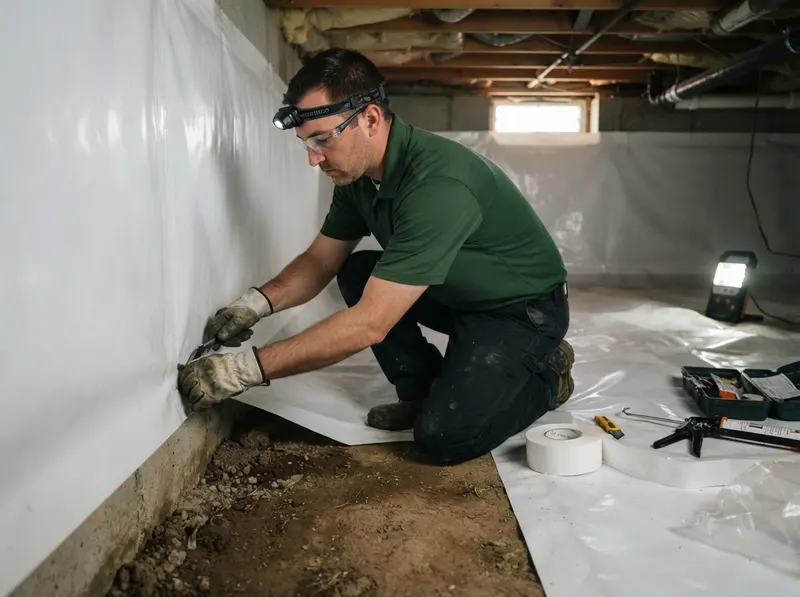
Sub-floor spaces in central Ohio experience intense moisture infiltration caused by dense clay soils and elevated humidity along the Olentangy and Scioto River basins. Unmitigated moisture beneath living areas softens joists and subflooring, transforming structural timber into a primary attractant for wood-destroying organisms. Subterranean termites require continuous ambient moisture above 70 percent relative humidity to expand mud shelter tubes across foundation walls, while camel crickets congregate in cool, saturated crawlspaces before migrating into finished first-floor rooms. Encapsulation arrests this biological cycle by isolating raw ground dirt from framing elements, depriving pests of necessary hydration and harborages. Homes with open foundation vents or torn dirt-floor plastic allow humid summer air to enter, which condenses against cooler air-conditioned subfloors and leads to sub-floor wood rot.
Targeted sub-floor management provides lasting protection for brick cottages in German Village, historic limestone basements in Victorian Village, and post-war ranches across Clintonville and Upper Arlington. Standard pest treatments rely on surface residual insecticides that degrade prematurely when applied to damp concrete or wet soil. Ground defense encapsulation pairs physical exclusion with environmental controls by anchoring continuous, antimicrobial vapor retarders across earth surfaces and mechanically fastening poly sheeting up foundation perimeter walls. Technicians seal sill plates and sub-floor penetrations with expanding barrier foam, blocking pathways used by centipedes, ground beetles, and subterranean termites. Routine mechanical air exchange can be regulated according to Energy Star sealing and insulation guidance to maintain optimal sub-slab dryness.
Effective defense requires managing both moisture volume and insect entry points concurrently. Installing a ground vapor retarder without closing rim joists allows perimeter insects to bypass foundation treatments, while sealing foundation vents without installing an impermeable ground cover traps earth dampness against subfloor framing, accelerating timber degradation. Ground barriers must adhere to standards established by the ASTM E1745 vapor retarder specification to resist punctures and stop soil gases. OakVanta Bug Specialists addresses moisture control and pest mitigation in a single clinical workflow, measuring relative humidity, checking wood moisture equivalence with digital pin meters, and applying perimeter treatments using products registered under the EPA pesticide program. This method resolves the source conditions drawing pests into the structure without displacing families or introducing heavy chemical odors.
Every job gets a firm, written price after a free on-site visit.
Tell us about your crawlspace and basement moisture encapsulation defense job in Columbus and we'll send a clear, written quote, usually the same day.
 OakVanta Bug Specialists